
Friendship, Ambition, and Betrayal: The Social Network
MOVIESPOPULAR
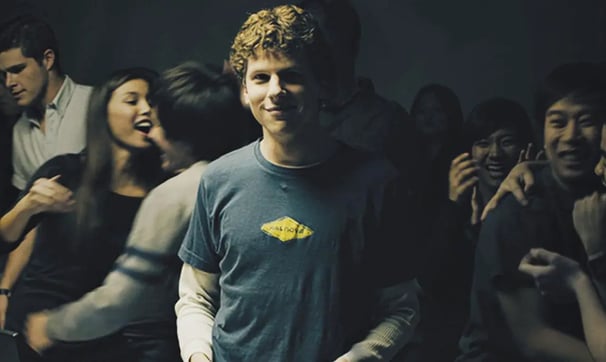
"The Social Network" is a film directed by David Fincher and written by Aaron Sorkin, released in 2010. The movie tells the story of the founding and subsequent legal battles surrounding the worldwide-known social network Facebook, with a particular focus on its creator, Mark Zuckerberg, portrayed by Jesse Eisenberg. While the movie is a dramatized account of real events, it provides insights into leadership and entrepreneurship are key aspects that a leader nowadays needs to achieve their goals.
The movie emphasizes the vision and "hunger" that Mark Zuckerberg has when he notices the potential that his idea has to transform it into one of the most popular and successful inventions of the modern era. What at first instantly starts as a "funny" idea to kill boredom with a couple of friends quickly evolves into a worldwide phenomenon, but how did they manage to do so? Quickly after the first "prototype" of what we know as Facebook got Mark Zuckerberg in trouble with the Harvard school board, it was a matter of time before Zuckerberg noticed the potential that a similar idea had to succeed in college society. College is, for many, the most social era of their life, so the possibility of "taking the whole social experience of college and putting it online" would ultimately mean commercial success, as social anxiety or fear of talking problems would be erased by bringing this experience online, allowing multiple opportunities for meeting new people that, for others, would be an exhaustive process.
Throughout the movie, we can observe how multiple friendships are formed and strengthened. In the case of the main character, his best friend and companion through the development of "Facebook" was Eduardo Saverin. At the time, Mr. Saverin studied Economics and was the president of the Harvard Investors Association at Harvard University. Taking into account that Mark Zuckerberg studied Computer Science, it may seem like a curious and out-of-place kind of partnership, but knowing the huge economic need for a social network to emerge and acquire the reliable reputation that it needs to attract new users, the need for an experienced person to handle the investments and work as CFO is fundamental. The possibility of gaining and attracting people to your idea is of high importance to guarantee the success of the idea, as when you are working on a starting business or developing any project, you will require the assistance of multiple people to guarantee its success since we are not capable of doing everything on our own.
During the movie, we can see how Mark acts a certain way when surrounded by people he knows and trusts, which is normal behavior. But when he is on the opposite side of the situation, surrounded by unknown people, it is evident that his comfort zone has been invaded, and he starts to act in a way that may push away certain people who may contribute to the development of his idea and himself. This is a clear example of what NOT to do to gain the trust of others and make them follow your idea. In this kind of situation, the optimal behavior is to show your interest in others just as they show interest in you to create an environment of security and affinity between yourself and the other individuals.
When Sean Parker appears on screen, we as viewers can see how Mark idolizes him and defends him from the accusations made by Eduardo. Here we can see how Eduardo and Mark’s relationship starts to crumble, even though both of them want the best for their company. As an Economics major, Eduardo sees things more realistically than Mark, and his preoccupation with the economic aspect of the company is highly emphasized. On the other hand, Mark sees Facebook not as a business but as a potential idea that, in his words, "we don't know what it is yet, we don't know what it could be, we don't know what it will be, we know that is cool.'' The topic quickly transforms into a recurring discussion between both of them and ultimately escalates into a bigger inner conflict in the new startup company. The participation of Sean Parker in the CFO decisions of the company ultimately ends up affecting the relationship between Eduardo and Mark even more, as it looks like Mark is replacing Eduardo and pushing him away from a company that both of them started. This attitude and behavior expressed by Mark is the exact opposite of what he should've done. Knowing the experience, abilities, and path that Eduardo has alongside him and how it makes him an enormously valuable asset for the development of the brand, Mark should've embraced his leadership skills and pursued him to keep trusting him, and most importantly, respected Eduardo’s position not only as CFO but as a co-founder of the company.
Concluding with the movie, Sean’s influence ends up taking over Mark, tending an ambush to completely push away Eduardo from the company, completely NON-LEADERSHIP BEHAVIOR. Throughout the movie, we as viewers experience a series of both appropriate and inappropriate leadership behaviors, which is a necessary thing to understand. Good leaders know which behaviors are optimal and which ones need improvement, so identifying which ones we can absorb and apply to our daily basis is a fundamental characteristic of a good leader.
Movie clips
”The Social Network is an electrifying look into Frankenstein's laboratory.”
- Rotten Tomatoes
Movie Reviews and Ratings